
When a manufacturer of subsea components decided to consolidate years of scattered operation sites into a single, purpose-built campus, it turned to a long-standing partner for a comprehensive, campus-scale pressure testing program. River Bend Industries (RBI) rose to meet that challenge, delivering custom-engineered enclosures, blast pit covers and full installation services that prioritized worker safety at every step.
Over the course of their relationship with RBI, this long-term customer had accumulated pressure testing enclosures across multiple satellite facilities in and around a major metropolitan area. When the decision was made to consolidate operations into one large, newly constructed campus, the scope of the project was significant: not only would new enclosures need to be manufactured, but existing units from the satellite sites would also need to be relocated and integrated into the new facility’s layout.
The company manufactures and refurbishes subsea components, which are products that must be pressure-tested to verify integrity before deployment. Because the components involved operate in extreme deep-sea environments, the testing requirements are demanding, with the majority of testing conducted at 30 ksi and some requirements at 15 ksi.
Safety was not simply a regulatory consideration; it was an internal mandate. The customer’s own safety culture and history drove the decision to invest in engineered enclosures rather than relying on improvised solutions or standoff distances alone. Pressure testing at these levels presents serious risk to personnel and property in the event of a catastrophic failure, and this customer understood that risk firsthand.
Unlike most customers who retrofit enclosures into an existing facility, this customer was working from a blank slate: a brand-new campus being designed from the ground up. This rare opportunity allowed RBI and the customer to hold multiple planning sessions ahead of construction, ensuring the enclosures, pit covers and process flow were designed into the facility rather than around it.
8
Custom Enclosures Manufactured and Installed
30
KSI Max
Testing Pressure
4
Blast Pit Covers
(60-ft and 80-ft)
Project Details
RBI’s scope for the campus covered two distinct categories of work: pressure testing enclosures and custom blast pit cover systems.
Pressure Testing Enclosures
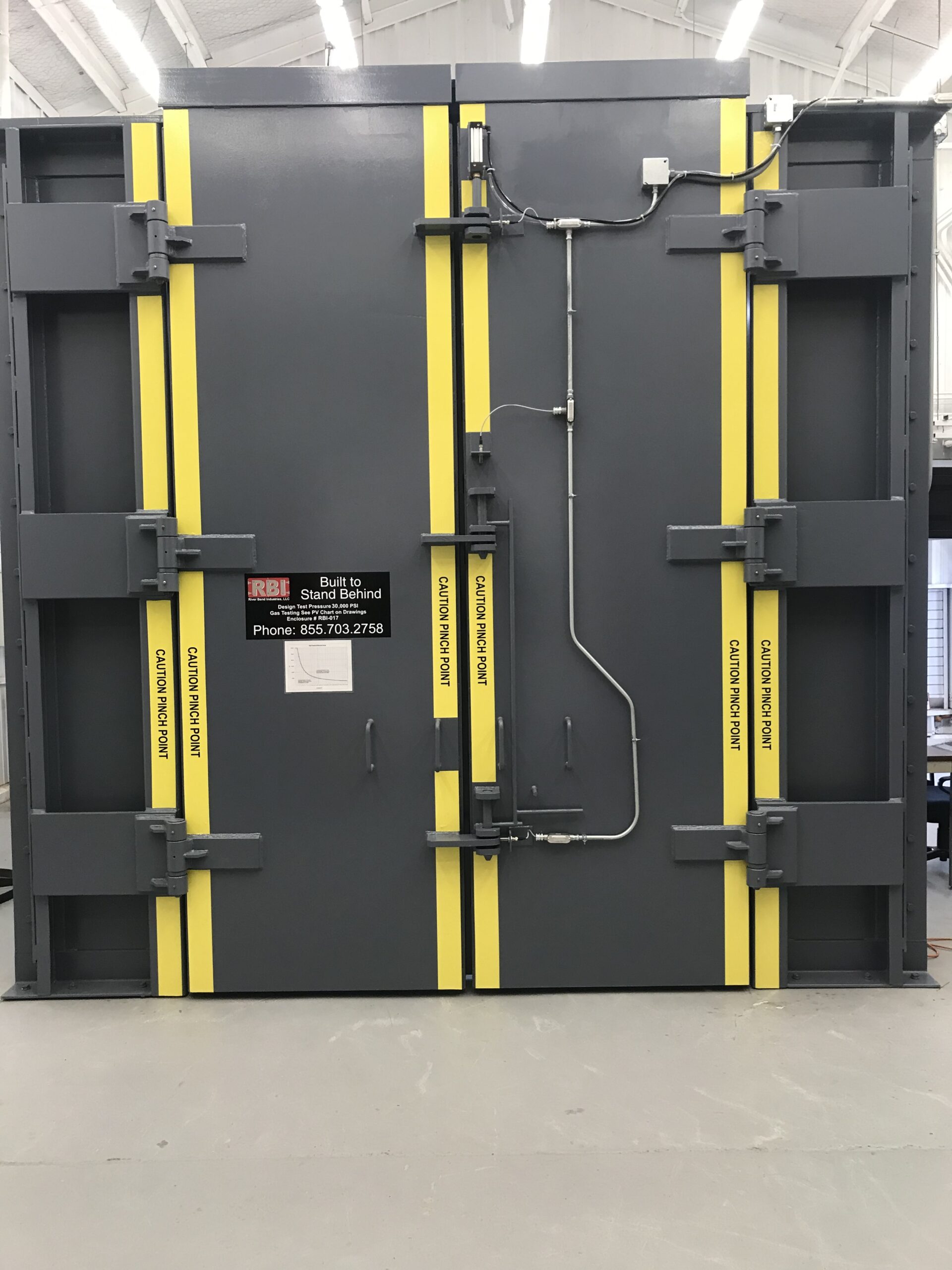
RBI manufactured and installed eight pressure testing enclosures for the new campus, sized to accommodate a range of component types and testing configurations:
- Five 10x10x10 testing enclosures rated at 30 ksi
- Two 20x20x20 testing enclosures rated at 30 ksi
- One 30x30x30 testing enclosure rated at 30 ksi
In addition to manufacturing new units, RBI relocated existing enclosures from the customer’s satellite facilities, consolidating the full array of testing equipment onto the new campus. The size range of the enclosures reflects the variety of subsea components the customer tests, ranging from individual valves and assemblies up to large-format blowout preventer (BOP) components and Christmas tree-style subsea valve assemblies.
Custom Blast Pit Cover Systems
A defining feature of the campus was a custom below-ground blast pit: a water-filled containment pit designed to provide an additional layer of protection during high-pressure testing operations. RBI was contracted to engineer and install the pit cover systems, which included:
- Fourteen pit doors and 28 winch units
- Two 60-foot pit covers
- Two 80-foot pit covers
The pit cover system serves a critical safety function: in the event of a catastrophic failure during testing, the lid secures the enclosure from above, containing any projectiles or debris within the pit. This combination of water-fill containment and engineered blast-rated covers represents a higher tier of protection than standard above-ground enclosures alone.
Direct Collaboration and Planning
Because RBI has worked directly with this customer for many years, with no general contractor or engineering firm as an intermediary, the project benefited from a highly collaborative planning process. RBI’s team participated in multiple pre-construction meetings to map out process flow, door orientation for loading and unloading, integration with existing press equipment and spacing requirements throughout the facility. The goal, as always, was to protect personnel and equipment without hindering production.
“Most of our projects are enclosures needed as an afterthought. Someone already has a facility and realizes they need an enclosure, and then they try to fit it in wherever it works. With this project, we had the rare opportunity to be part of the planning from day one.”
MATT WALLACE, RIVER BEND INDUSTRIES – PRODUCTION MANAGER
This project stands as one of RBI’s most comprehensive campus-scale deployments to date. By serving as the engineering and installation partner for both enclosures and blast pit cover systems, RBI helped a long-term customer build a centralized, safety-first testing operation from the ground up. The facility is now equipped to handle high-pressure subsea component testing across a wide pressure range, with the containment engineering to match.
For manufacturers and refurbishers working in high-pressure environments, RBI’s ability to custom-engineer, manufacture, relocate and install testing enclosures of any scale, and to collaborate as a direct partner from planning through commissioning, makes the difference between a testing program that was retrofitted and one that was built right from the start.
Product Description
RBI’s pressure testing enclosures are built to withstand high-energy failures during hydrostatic and pressure testing operations. Rated to 30 ksi and customizable in size, orientation and configuration, they are engineered to protect workers, equipment and facilities in environments where standard barriers are insufficient. RBI also designs and installs blast pit cover systems, including winch-operated pit doors for below-ground water-fill containment pits, providing a full spectrum of testing safety infrastructure for industrial and manufacturing operations.
